1930s: Nuclear Discovery
The 1930s was the age of atomic discovery
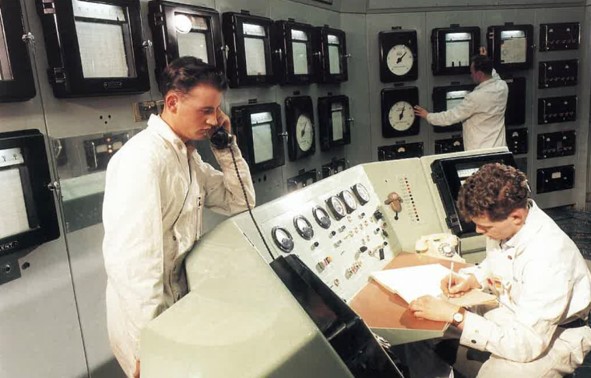
The 1930s was the age of atomic discovery. The neutron was identified and the first controlled splitting of an atom took place. This enabled physicists to see how Albert Einstein’s energy theory E=mc2 worked in practice.
The discovery of nuclear fission using uranium proved that a nuclear chain reaction was possible. The Second World War shifted the focus of research to weapons production.
Nuclear Fission
Nuclear fission was discovered by Otto Hahn and Fritz Strassmann in December 1938 and explained theoretically in January 1939 by Lise Meitner and her nephew Otto Frisch. A few months later, Frederic and Irène Joliot-Curie, Hans Von Halban and Lew Kowarski, working in Paris and the UK, discovered neutron multiplication in uranium, proving that a nuclear chain reaction was possible.
A controlled reaction is required for power production and uncontrolled for weapons.
The Nuclear Fission process
- A fissile atomic nucleus, such as that containing the uranium 235 isotope is bombarded with neutrons
- It splits into several smaller fragments and releases 2 or 3 neutrons
- The neutrons released produce an additional fission in at least one further nucleus
- This nucleus in turn produces 2 or 3 further neutrons and the process repeats exponentially – known as a chain reaction